





2027 RAM 1500 Towing & Payload Capacity
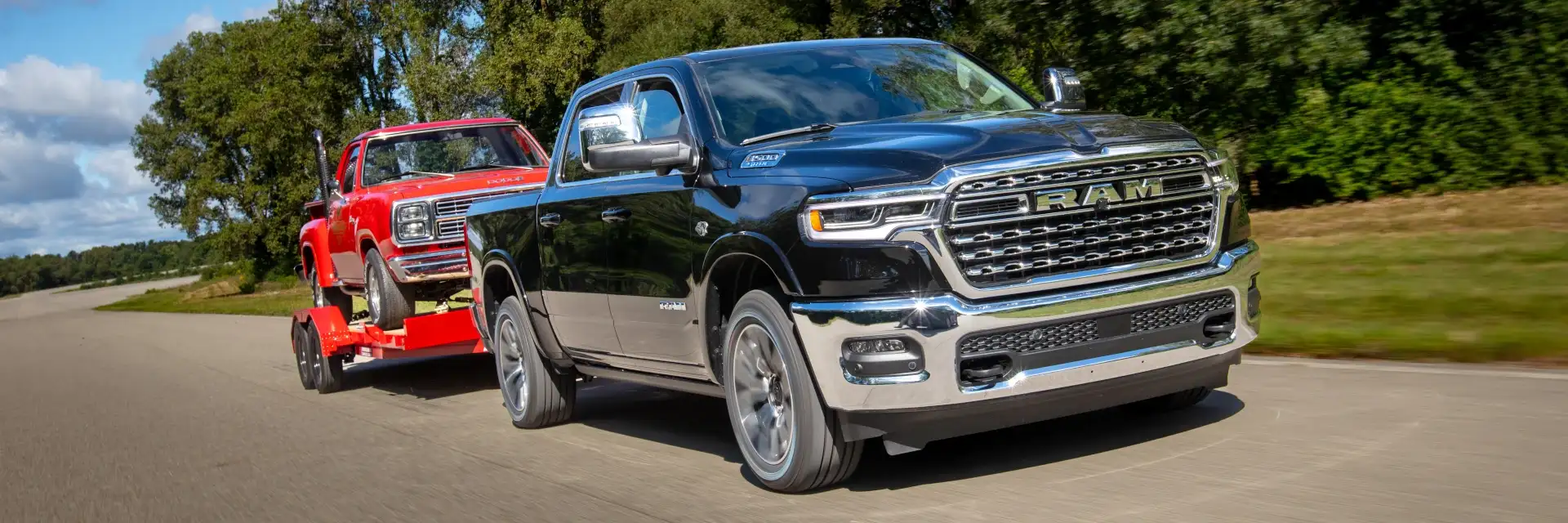
Table of Contents:
- Towing Capacity vs Payload Capacity
- 2027 RAM 1500 Capacity Ratings by Engine
- 2027 RAM 1500 Capacity Ratings by Trim
- How Configuration Choices Affect Performance
- Finding Your Ideal RAM 1500 Setup
- Frequently Asked Questions
Bottom Line Up Front: The 2027 RAM 1500 offers up to 2,340 pounds of maximum payload capacity and up to 11,530 pounds of maximum towing capability when properly configured, backed by America’s most powerful lineup of full-size gas light-duty pickup trucks. This guide covers everything you need to match the right engine, trim, and configuration to your actual work and towing demands.
Half-ton truck shoppers have more choices than ever, and the 2027 RAM 1500 gives you a genuine reason to choose differently. Four gasoline engines spanning a 235-horsepower range, coil-spring rear suspension that no competitor matches, class-exclusive inline-six options, and a trim lineup that runs from no-frills work truck to genuine luxury SUV alternative. The numbers you care about — towing and payload — depend heavily on which engine and configuration you choose. Here’s how to read them correctly.
Towing Capacity vs Payload Capacity
What Is Payload Capacity?
Payload capacity is the total weight your truck can safely carry across the cab and bed combined. That number covers everything you add after the truck leaves the factory: passengers, tools, gear, a tonneau cover, a toolbox, a gooseneck prep kit, everything. RAM calculates payload by subtracting the truck’s curb weight from its Gross Vehicle Weight Rating (GVWR). The specific number for your exact build is printed on the certification sticker inside the driver’s door jamb, and that sticker is the number that matters, not the maximum advertised figure for the model.
What Is Towing Capacity?
Towing capacity is how much your RAM 1500 can safely pull on a trailer behind it, whether that’s a boat, a travel trailer, horses, or equipment. The rating depends on your engine, axle ratio, cab style, box length, and installed towing equipment. The 2027 RAM 1500 reaches its class-competitive 11,530-pound maximum towing rating through the standard-output 3.0L Hurricane twin-turbo inline-six with the right configuration and tow-rated axle.
Why Both Numbers Matter
A truck can carry a strong tow rating on one engine and a strong payload rating on a different one, which means getting both right requires thinking about your primary use case before you configure. Contractors who load the bed with materials every day need payload. Weekend tower hauling a 28-foot travel trailer or a loaded boat to the Gulf prioritizes towing. Buyers who do both jobs regularly benefit from the 5.7L HEMI V8, which delivers solid numbers across both categories without requiring any premium fuel. The RAM 1500’s four-engine lineup gives you real flexibility to build around your actual habits rather than the maximum marketing figure.
2027 RAM 1500 Capacity Ratings by Engine
Engine selection drives capability more than any other single choice on the RAM 1500. The 2027 model offers four core powertrains for the standard lineup, each with a distinct performance and capability profile.
| Engine | Horsepower | Torque (lb-ft) | Max Towing (lbs) | Max Payload (lbs) |
|---|---|---|---|---|
| 3.6L Pentastar® V6 | 305 hp | 269 | 8,100* | 2,340* |
| 5.7L HEMI® V8 | 395 hp | 410 | 11,470* | 1,760* |
| 3.0L Hurricane Twin-Turbo I6 | 420 hp | 469 | 11,530* | 1,880* |
| HO 3.0L Hurricane Twin-Turbo I6 | 540 hp | 521 | 9,480* | 1,530* |
*Ratings vary by configuration, cab style, box size, axle ratio, and installed options. Maximum figures require proper equipment including the appropriate tow-rated axle and Class IV hitch package. The HO 3.0L Hurricane is fitted to performance and off-road trims (RHO, TRX SRT) where additional hardware reduces payload and towing relative to the standard Hurricane.
A note on the Hurricane engines: RAM calls the 3.0L Hurricane the only class-exclusive available gas inline-six in the segment. The standard-output version delivers the highest towing ceiling at 11,530 pounds. The High-Output version makes 540 horsepower, more power per liter than any competitor in class, but because it lives in heavier performance-oriented trucks, its towing ceiling sits lower at 9,480 pounds. Picking the right Hurricane depends entirely on whether raw power or maximum towing matters more to you.
2027 RAM 1500 Capacity Ratings by Trim
The 2027 RAM 1500 spans thirteen trim levels across three buyer groups. Which engines you can order, and how heavy the truck is from the factory, determines your actual capability ceiling. Heavier luxury trims with more standard hardware typically carry lower payload ratings even when fitted with a strong engine.
| Trim Level | Available Engines | Max Payload (lbs) | Max Towing (lbs) |
|---|---|---|---|
| Tradesman | 3.6L Pentastar V6, 5.7L HEMI V8, 3.0L Hurricane I6 | 2,340* | 11,530* |
| Express / Black Express | 3.6L Pentastar V6, 5.7L HEMI V8, 3.0L Hurricane I6 | 2,235* | 11,470* |
| Big Horn / Lone Star | 3.6L Pentastar V6, 5.7L HEMI V8, 3.0L Hurricane I6 | 1,920* | 11,530* |
| Warlock | 3.6L Pentastar V6, 5.7L HEMI V8, 3.0L Hurricane I6 | 1,800* | 11,200* |
| Laramie | 5.7L HEMI V8, 3.0L Hurricane I6, HO 3.0L Hurricane I6 | 1,880* | 11,400* |
| Rebel / BackCountry | 5.7L HEMI V8, 3.0L Hurricane I6 | 1,600* | 11,140* |
| RHO | HO 3.0L Hurricane Twin-Turbo I6 | 1,530* | 9,480* |
| Limited / Limited Longhorn / Tungsten | HO 3.0L Hurricane Twin-Turbo I6 | 1,530* | 9,120* |
| TRX SRT / Rumble Bee SRT | Supercharged 6.2L HEMI® V8 | Varies* | Varies* |
*Payload and towing figures vary depending on specific cab style, box size, axle ratio, drivetrain, and selected options. Always confirm your actual ratings on the certification sticker in the driver’s door jamb, which accounts for your truck’s exact build.
Getting to Maximum Towing
Reaching 11,530 pounds requires more than the right engine. The full towing package for the 2027 RAM 1500 includes:
- The 3.0L Hurricane twin-turbo inline-six with the appropriate tow-rated axle ratio (3.21 or 3.55 depending on configuration)
- A Class IV hitch receiver and integrated trailer brake controller, available as part of the towing package
- Crew Cab or Quad Cab configuration with the 5-foot 7-inch or 6-foot 4-inch bed
- Available RAM’s Trailer Reverse Steering Control and Surround View Camera to simplify hookups and backing maneuvers
How Configuration Choices Affect Performance
Cab Style
The RAM 1500 comes in three cab configurations: Regular Cab, Quad Cab (extended cab), and Crew Cab. Regular Cab trucks carry the highest payload ratings because they weigh less, and this is where you find the Tradesman’s top payload figures. Quad Cab adds real rear-seat space with rear-opening half-doors, a solid choice for crews who occasionally need to carry passengers without giving up a full-size bed. Crew Cab is the most popular option on the lot, offering full rear doors and a proper backseat, and it’s compatible with the 5-foot 7-inch or 6-foot 4-inch bed. For towing, Crew Cab in the right configuration reaches the same 11,530-pound ceiling as the Quad Cab with the proper equipment, so the choice there is more about how you use the back seat than the numbers.
Drivetrain: 4×2 vs 4×4
Two-wheel-drive trucks generally carry more payload than 4×4 equivalents because they skip the transfer case and front axle hardware, saving roughly 200 to 250 pounds depending on the build. For buyers in the Fort Walton Beach area spending most of their time on pavement and job sites, a 4×2 is a practical way to squeeze more hauling capacity out of the same engine. Four-wheel drive earns its place when you regularly deal with beach access, sand, soft shoulders, or any surface where traction becomes a real concern. Towing ratings are competitive across both drivetrains when the truck is properly equipped.
Bed Length
Bed length doesn’t change your payload number, but it shapes how that capacity works in practice. The 5-foot 7-inch bed fits most parking garages and is the standard choice for Crew Cab buyers who don’t routinely haul full sheets of plywood or long pipe. The 6-foot 4-inch bed handles most contractor tasks and is available with both Quad Cab and Crew Cab. The longer bed also tends to improve trailer tongue weight distribution when the bed carries gear while towing. Regular Cab configurations are available with a longer bed option, which is the setup for buyers who need maximum cubic footage and don’t need rear-seat space.
The Coil Spring Rear Suspension Advantage
The RAM 1500’s coil-spring rear suspension is unique in the segment. Every other full-size half-ton uses leaf springs out back. Coil springs deliver a noticeably smoother, more car-like ride when you’re running empty, which is most of the time for the average buyer. When equipped with the available Four-Corner Active-Level Air Suspension, the RAM 1500 adjusts ride height automatically for highway efficiency and lowers to help with trailer hookup. That system also maintains a level stance under load, which is relevant both for towing feel and for keeping headlight aim consistent when the bed is full. The Rebel and Warlock get 33-inch all-terrain tires and a lifted suspension for buyers who want legitimate off-road capability without stepping into the RHO or TRX territory.
The Hurricane Engine Decision
Choosing between the standard 3.0L Hurricane and the High-Output version comes down to a genuine trade-off. The standard Hurricane delivers 420 horsepower and 469 lb-ft of torque, reaches 11,530 pounds of towing, and fits in the Tradesman, Big Horn, Laramie, and Rebel trims. It’s the right engine for buyers who want the best towing numbers in the RAM lineup and don’t need the performance-truck hardware that comes with the HO version. The HO Hurricane produces 540 horsepower and 521 lb-ft, more power per liter than any competitor in class, and slots into the RHO, Limited, Longhorn, and Tungsten. Because those trims are heavier, towing actually steps down to 9,480 pounds despite the engine’s additional output. If maximum towing is the goal, the standard Hurricane in a Tradesman, Big Horn, or Laramie is the path.
Finding Your Ideal RAM 1500 Setup
The right 2027 RAM 1500 looks different depending on what you’re actually doing with it. Contractors and tradespeople who need maximum payload and the ability to move heavy loads daily are best served by the Tradesman in a Regular Cab or Quad Cab with the 3.6L Pentastar V6 and a 4×2 drivetrain, where the 2,340-pound payload ceiling lives. For buyers who primarily tow and want to reach 11,530 pounds, the Tradesman, Big Horn, or Laramie in a Quad Cab or Crew Cab with the 3.0L Hurricane and a properly rated axle gets there. The 5.7L HEMI V8 remains the balanced all-rounder: 395 horsepower, 11,470 pounds of towing, proven reliability, and no premium fuel preference.
Buyers looking for a capable daily driver with a premium interior have solid options in the Laramie and Limited, and the Tungsten stands as one of the most genuinely luxurious half-tons on the market. Off-road shoppers have the Rebel, Warlock, and RHO to choose from, each with a different balance of price and performance.
What makes the 2027 RAM 1500 worth a hard look is the combination of the class-exclusive inline-six engine options, the best-in-segment ride quality from the coil-spring rear suspension, and a trim lineup deep enough to cover buyers from work-truck simplicity to full-luxury territory, all in the same platform.
Ready to talk through which configuration fits your situation? Visit Step One CDJR Fort Walton at 541 Mary Esther Cut Off NW, Fort Walton Beach, FL 32548. Our team can walk you through door-jamb payload stickers, tow packages, axle ratios, and the trucks we have in stock right now. Reach out online or stop in any time.
RAM Dealership Serving:
2027 RAM 1500 Towing and Payload Frequently Asked Questions
What is the maximum payload capacity of the 2027 RAM 1500?
The 2027 RAM 1500 reaches up to 2,340 pounds of maximum payload when configured with the 3.6L Pentastar V6 in a lighter cab configuration. That figure assumes a specific build, and your actual truck will have a different number printed on the certification sticker in the driver’s door jamb based on your exact cab, engine, drivetrain, and options. Always go by the door-jamb sticker for real-world planning, not the advertised maximum.
How much can the 2027 RAM 1500 tow?
The 2027 RAM 1500 achieves a maximum towing rating of 11,530 pounds using the standard-output 3.0L Hurricane twin-turbo inline-six with the proper axle and towing equipment in the right cab-and-box configuration. The 5.7L HEMI V8 reaches 11,470 pounds. The High-Output Hurricane tops out at 9,480 pounds in the RHO and performance trims where the added truck weight caps the ceiling. The base 3.6L Pentastar V6 is rated up to 8,100 pounds.
What makes the 2027 RAM 1500 different from the competition?
A few things stand out. The coil-spring rear suspension is unique among full-size half-tons and delivers a ride quality advantage when the truck is running empty, which is most of the time for most owners. The class-exclusive 3.0L Hurricane inline-six engines give buyers a genuine alternative to V8 and V6 options with strong torque output at lower RPM. The available Four-Corner Active-Level Air Suspension automatically adjusts ride height for efficiency on the highway and levels the truck under load. And the RAM 1500 Tungsten makes a legitimate case as the most luxurious production half-ton on the market today.
Which 2027 RAM 1500 engine gives the best balance of towing and payload?
The 5.7L HEMI V8 is the all-around choice for buyers who want solid performance across both categories. At 395 horsepower, 410 lb-ft of torque, 11,470 pounds of towing, and up to 1,760 pounds of payload, it handles nearly any real-world task without requiring premium fuel or the additional cost of the Hurricane package. The standard 3.0L Hurricane beats it slightly on both towing and payload ceiling numbers, and its twin-turbo torque curve makes it feel strong pulling from a stop. The Hurricane is the pick for buyers who regularly work near those maximums. The Pentastar V6 makes sense when payload is the first priority and towing demands stay light.
What equipment does the 2027 RAM 1500 require for maximum towing?
Reaching the 11,530-pound towing ceiling requires the 3.0L Hurricane engine, a tow-rated rear axle (3.21 or 3.55 ratio depending on the build), an integrated trailer brake controller, and a Class IV hitch receiver. Weight-distribution hitches are recommended for heavier trailers above 5,000 pounds. RAM also offers Trailer Reverse Steering Control, which automates the steering inputs when backing a trailer, and a Surround View Camera system with a trailer camera input.
How does the RAM 1500 RHO compare to the standard lineup for towing and payload?
The RHO is RAM’s purpose-built off-road performance truck and carries the High-Output 3.0L Hurricane engine at 540 horsepower. Because the RHO adds factory Bilstein shocks, lifted suspension, 35-inch tires, skid plates, and other off-road hardware, the truck is heavier than the work-focused trims. That weight reduces the towing ceiling to 9,480 pounds and payload to around 1,530 pounds. The RHO is the right truck when off-road capability and sheer engine output matter most, with the understanding that it isn’t optimized for maximum hauling numbers.
Does the 2027 RAM 1500 offer a hybrid powertrain option?
The 2027 RAM 1500 does not offer a traditional plug-in or full hybrid configuration in the standard lineup. Several engines are available with eTorque mild-hybrid assist, which adds a 48-volt belt-integrated starter-generator for improved off-the-line torque response and light fuel efficiency improvement under normal driving. The RAM 1500 REV is RAM’s dedicated electric pickup, sold separately from the standard 1500 lineup. For buyers in the Fort Walton Beach area who want utility features during outdoor activities, the RAM 1500’s RamBox bed storage system and available cargo-management accessories serve as practical alternatives to the onboard generator features found in some competing trucks.
0 comment(s) so far on 2027 RAM 1500 Towing & Payload Capacity